

Bitcoin running culture: place, pace and the stories a tee can carry
Explore Bitcoin running culture through Lugano’s Run For Hal, and how place, distance and remembrance can inspire meaningful graphic tees.
In this story
A meeting point beside a lake. An early start. Five kilometres with room for conversation rather than a contest against the clock. These details offer a different way into Bitcoin culture: not through a screen, a price chart or an oversized coin symbol, but through people choosing to spend time together. They also suggest a richer starting point for graphic clothing. A tee can carry the memory of a shared morning without turning that memory into a slogan shouted across the chest.
The useful question is not whether running and Bitcoin naturally belong together. It is what a particular gathering allows people to express. Lugano’s Run For Hal provides a concrete example: a scheduled social run with a named place, a modest distance and a commemorative purpose. From those ingredients, it is possible to think about Bitcoin running culture as a practice of meeting and remembering—and about clothing as one way of giving that practice a lasting, personal form.
A lakeside gathering, not a victory lap
The Plan ₿ Week event listing scheduled Run For Hal for 23 October 2026, from 06:50 to 08:00, at Villa Ciani in Lugano. It described a free, easy-paced five-kilometre lakeside social run honouring Hal Finney and welcoming every ability. The wider organiser schedule placed Plan ₿ Week across 19–28 October. Those are the published arrangements, not evidence of how many people attended or whether the run took place exactly as planned.
That distinction matters when translating an event into a cultural story. There is no need to invent a crowded starting line, a particular sunrise or an emotional finish. The listing already supplies something meaningful: an invitation to gather around remembrance, with an accessible pace rather than a performance target. Its interest lies in the structure of the invitation. People are offered a shared activity through which a name can be remembered, rather than simply displayed.
For a graphic tee, this is a more useful foundation than manufactured grandeur. Villa Ciani, the date and the distance are specific enough to anchor an idea. The commemorative purpose gives those details weight. None requires an assertion that the gathering transformed a city or defined an entire community. A small, precisely told story can carry more feeling than a sweeping claim about a movement.
What connects Bitcoin culture and running?
In this example, the connection is a shared ritual. A Bitcoin gathering makes space for a run, and the run gives participants something to do together beyond discussing Bitcoin. Distance supplies a common task; a meeting point turns an abstract network of interests into a physical encounter. The commemorative dedication supplies another layer: the outing is organised around remembering someone, not merely occupying the same stretch of lakeside.
Running can also make conversation feel less formal. As a design interpretation, the appeal is easy to understand: people moving in the same direction, with neither a stage nor a lectern between them. That does not mean every runner has the same beliefs, or that an easy-paced event removes every barrier to participation. It means the listed format offers a different social arrangement from a presentation or a debate, with its own possibilities for connection.
The link is therefore more interesting than a loose comparison between endurance and conviction. Such metaphors can quickly make exercise sound like a test of financial loyalty. Here, the stronger story concerns presence: showing up at a stated place, making time for others and recognising a commemorative purpose. Clothing inspired by that story should not need to turn physical effort into proof that someone belongs.
Let place do some of the talking
Place gives a designer material that a generic emblem cannot. The words “Villa Ciani” and “Lugano” locate an idea without explaining everything about it. A proposed design might give the meeting point the prominence usually reserved for a headline, with the city set beneath it in smaller type. That hierarchy would make the shirt read first as a record of somewhere, and only later as an invitation to ask why that somewhere matters.
A route line is another possibility, but it requires care. The supplied listing establishes a lakeside run, not a verified course map. An original graphic could use an abstract line to suggest movement alongside water; it should not pass off an imagined route as the actual five-kilometre course. If accuracy is central to the design, the route would need to be confirmed before its turns and contours became part of the artwork.
This is where restraint becomes useful. A single line, a place name and a carefully spaced distance could make a coherent composition without borrowing event artwork. These are editorial proposals, not descriptions of an existing Crypto Style Tees product. Their purpose is to show how original graphics might emerge from a setting while respecting the difference between inspiration, documentation and official identity.
Five kilometres as a graphic language
“5 km” has a useful clarity. It describes a distance before it becomes a metaphor. On a proposed tee, those characters could sit alone near the centre, or appear as a quiet marker within a larger typographic arrangement. The point would not be to make a short social run resemble an elite achievement. It would be to recognise the scale of the shared activity without inflating it.
Distance markers also suggest sequence. An original design might use five small divisions to give the eye a rhythm, allowing the composition to unfold rather than resolve into one dominant badge. Those divisions would be a graphic interpretation of distance, not claims about official checkpoints. Keeping that distinction clear leaves room for invention while avoiding the false authority of a race diagram that was never supplied.
The language of endurance already appears in the Crypto Style Tees HODLing Through the Pain – Meme Coin Marathon T Shirt. Its catalogue story uses a marathon as a metaphor for holding meme coins through market swings. That makes it a useful contrast, not a Run For Hal substitute. A commemorative running concept can move away from market struggle altogether, placing company, memory and an ordinary shared distance at its centre.
Remembrance needs room to breathe
A commemorative tee has a different responsibility from a joke tee. It asks a name or a dedication to carry emotional meaning, which makes tone important. Large declarations can crowd out the very person being remembered. An imagined design centred on a small dedication, with place and distance supporting it, might leave more room for reflection than a chest filled with competing statements about strength, legacy and belonging.

Dates need the same care. “23 October 2026” is supported as the scheduled event date; it is not, on its own, proof of attendance or completion. In an editorial concept, it can identify the occasion that inspired the work. But wording such as “finisher”, “I was there” or “official participant” would introduce claims that the listing cannot establish. Graphic confidence should come from composition, not from borrowing credentials.
Nor should inspiration imply affiliation. An independently conceived tee can explore the cultural meaning of a gathering without presenting itself as authorised event merchandise. Avoiding copied artwork is part of that boundary; avoiding an official-sounding voice is another. The most thoughtful result would make its own visual argument about place and remembrance, rather than trying to look as though it had been collected from an event registration desk.
Wearing community without making a uniform
There is also a broader wardrobe question here: how much explanation should a tee demand? A highly specific place-and-distance design might be legible to its wearer long before it is legible to anyone else. That is not a weakness. Clothes can hold private associations as well as public messages. Someone may ask about a date or a line, but the design need not turn every encounter into a prepared speech.
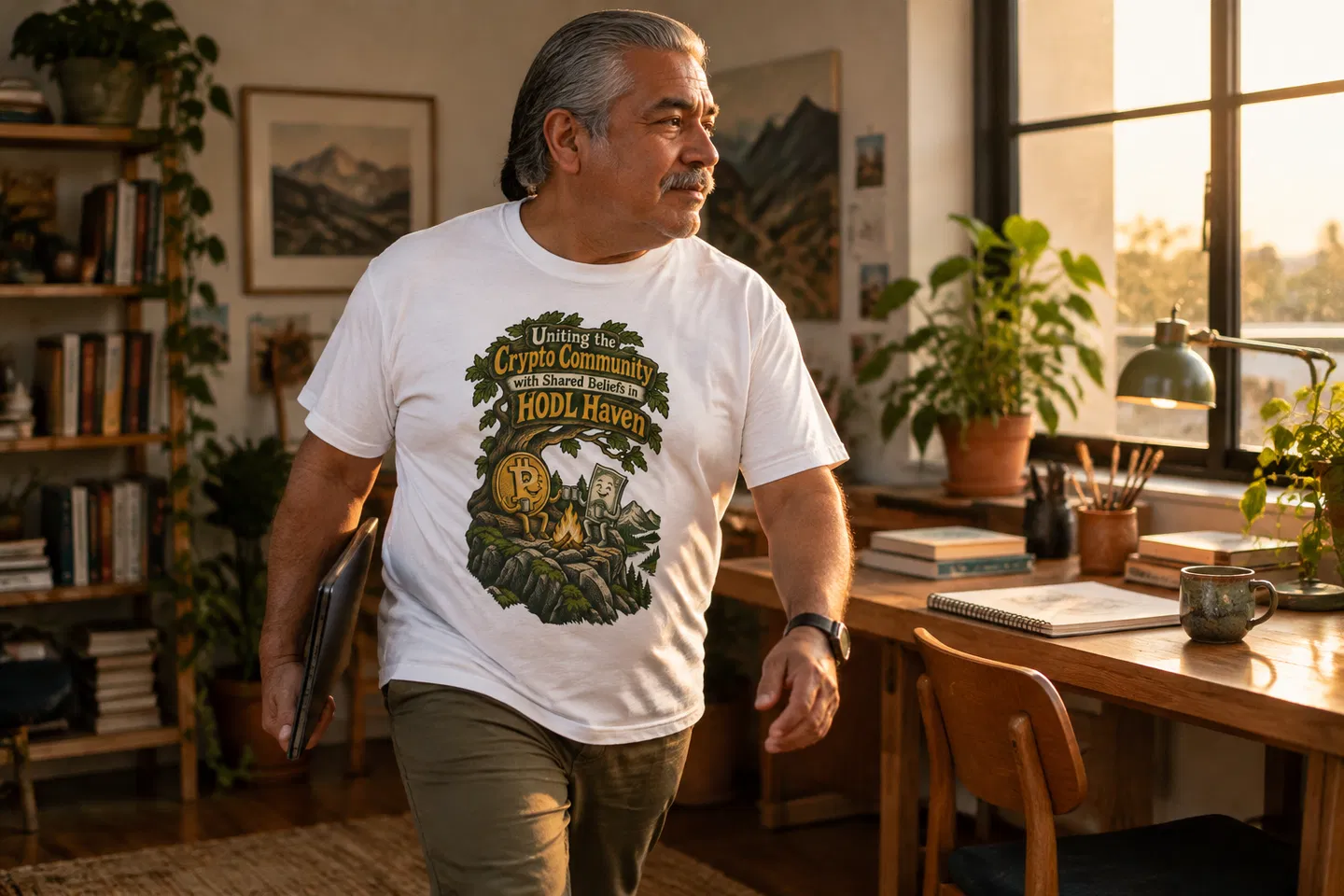
Crypto Style Tees’ HODL Haven T Shirt offers a separate, community-focused point of reference. Its catalogue narrative centres on unity and shared conviction. That theme can sit alongside this discussion without suggesting any connection to Run For Hal. The distinction is worth preserving: a general expression of community and a graphic grounded in a particular commemorative occasion tell different kinds of story.
For personal styling, give whichever story you choose enough space. A graphic tee with plain trousers and an open overshirt can feel considered without becoming ceremonial. For a more casual combination, shorts and familiar trainers keep the emphasis on the wearer rather than a fully themed outfit. These are everyday styling suggestions, not claims about technical running suitability. A culturally relevant tee is not automatically exercise kit.
A meaningful tee begins with attention
The lesson from the Run For Hal listing is not that every Bitcoin design needs a running reference. It is that specificity can replace volume. A place, a distance, a time and a commemorative intention offer enough material to ask better design questions. Which detail deserves emphasis? What should remain quiet? What can be interpreted freely, and what needs verification before it becomes a printed claim?
Those questions also help keep the human subject in view. Rather than using a gathering as a convenient excuse for another emblem, a designer can consider what the invitation actually offered: an easy-paced lakeside run, open to every ability, in honour of Hal Finney. That is a modest foundation, but not a thin one. Its meaning comes from the relationship between shared movement and shared remembrance.
A good graphic does not have to explain that relationship exhaustively. It might offer a place name, a measured interval or a line that gives the eye somewhere to travel. The rest can belong to the person wearing it. When a tee leaves space for memory and conversation, it becomes more than a declaration of allegiance. It becomes something quieter and more particular: a way to carry a story into another ordinary day.