
Culture
A graphic tee for a city day
Choose a graphic tee for a city day with practical checks for bag straps, event badges and layers, inspired by Mumbai’s Devcon 8.

In this story
Mumbai’s Jio World Centre was the venue listed for Devcon 8 on 3–6 November 2026. The organiser’s guide described talks, workshops and Community Hubs, alongside one particularly practical requirement: attendees needed to keep their entry badge with them. For anyone building a day around an event, that small object becomes part of getting dressed. It occupies some of the same space as the artwork on a graphic tee.
A bag strap introduces another line across the chest. An open shirt frames the print, then closes over it when you sit down. Before the first conversation, the design you chose can already be partly hidden. Devcon provides the starting point for this photo essay; the café stops and styling scenes below are illustrative, rather than observations of attendees or documentary coverage of the gathering.
Before the café: check the whole outfit
Picture the first stop: a café table, a bag beside the chair and a layer folded over its back. With everything put down, the tee has room to show. That is also the easiest version of the outfit. The useful test happens before leaving home, when the bag is loaded and every item you intend to wear is in place.
Start with the actual design. Look at the product imagery, or the tee itself if you already own it, and identify what you want to remain visible. A graphic may still make sense with part of it covered; a phrase can lose its meaning when one word disappears. There is no need to guess at placement from a product title. Check where the artwork sits against your own bag and layers.
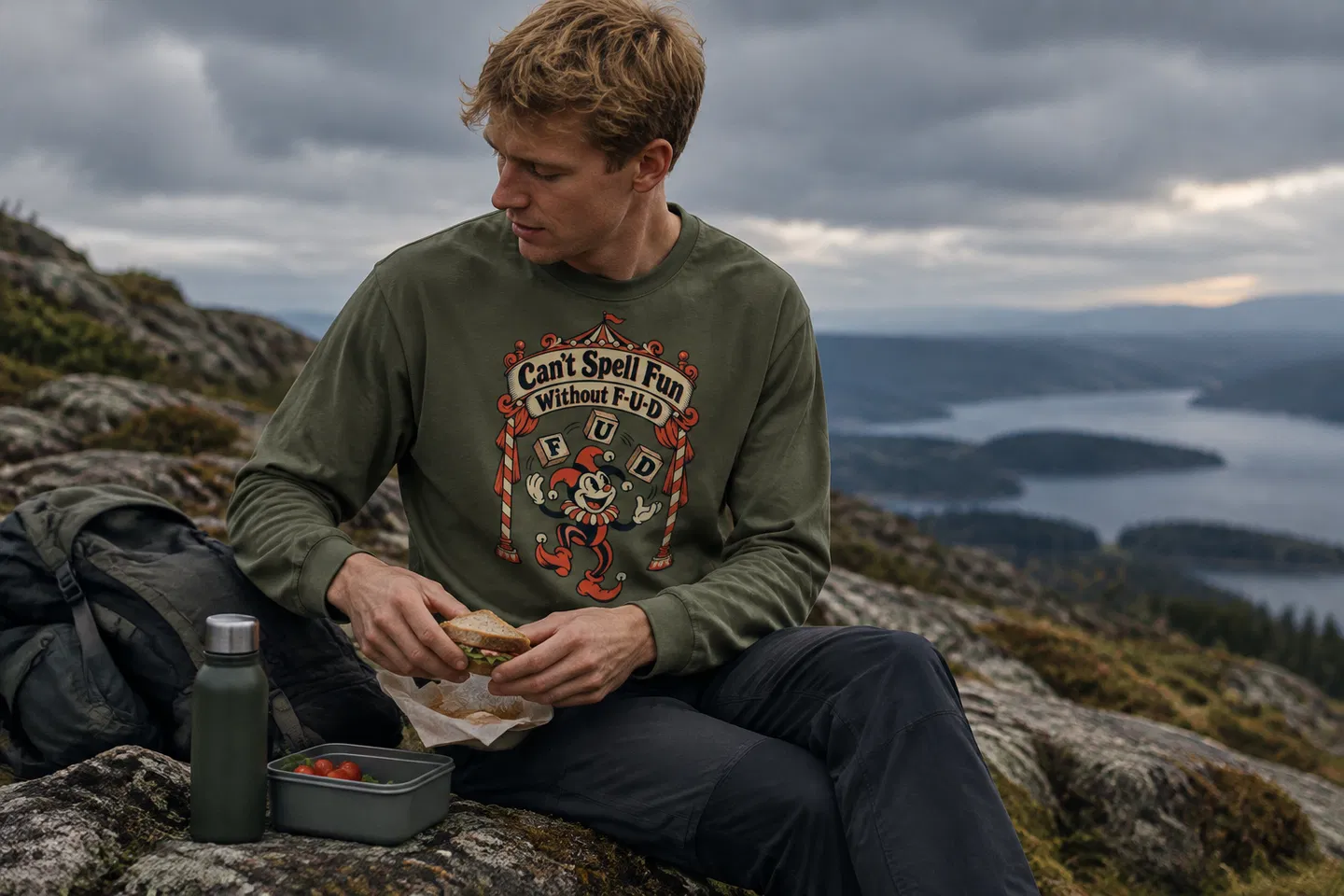
Our Can’t Spell Fun Without F-U-D V-neck T-shirt brings a particular kind of crypto humour into that decision. The title plays on familiar community language. If that joke is why you have chosen it, give the design enough space to communicate. The practical styling question is whether your everyday belongings leave the part you value unobstructed.
For a useful mirror check, stand normally with the bag carrying its intended contents. Then turn slightly and sit down. A strap that appears clear of the design when you arrange it carefully may cross it again as soon as you move. Take a quick phone photograph if it helps: a full-outfit view can make an obstruction more obvious than looking down at your chest.
*Illustrative frame: a café doorway, with the bag worn as it would be on the street. The point of the image is the relationship between strap and tee, rather than a perfectly cleared outfit.*
On the pavement: follow the strap

A crossbody bag puts a diagonal across the front of the body. Whether that interrupts the artwork depends on the particular tee, the strap’s position and where the bag rests. Try the bag on both sides before settling on one. If switching shoulders leaves more of the design visible without making the bag awkward to reach, that is a useful adjustment.
Strap length is worth testing too, within the bag’s intended adjustment range. Move it a little, walk around and check again. Avoid choosing a position that only works while you hold the bag in place. A city day involves reaching for a phone, stepping through doorways and sitting on public transport. You should be able to do those ordinary things without repeatedly resetting the outfit.
If a diagonal keeps cutting through the part of the design you want to show, consider a different carrying arrangement using something you already own. A backpack leaves the centre of the chest clearer, although its shoulder straps still need checking. A hand-carried bag removes the diagonal but occupies a hand. Neither is an automatic improvement; the right choice depends on what you need to carry and how you prefer to move.
Keep access in mind as well as appearance. Put frequently used essentials somewhere you can reach without opening the whole bag. Repeatedly pulling a bag forwards can change where the strap sits. Reducing that fuss is more useful than finding a photogenic position that lasts only until the next time you need your phone.
At the entrance: make room for the badge
The Devcon organiser’s instruction to keep an entry badge with you gives this styling problem a firm boundary. Entry requirements come first. Our suggestion is to work around the badge, following whatever display instructions the organiser provides. Do not tuck it away simply to reveal more artwork if it needs to remain visible or accessible.
Once those requirements are clear, look at the badge and strap together. A lanyard can introduce a second set of lines over the tee, with the badge itself occupying a larger patch below. If its attachment allows adjustment, and the event’s rules permit it, check whether a different resting position leaves the design more legible. Keep the badge easy to use and avoid makeshift arrangements that could lose it.
There may be no entirely clear space. That is an ordinary limitation of an event outfit. If the badge covers part of the graphic, you can still reduce other obstructions: open the outer layer or move a bag strap where practical. Trying to preserve every centimetre of print is unlikely to be worth a day of fiddling with your clothes.
*Illustrative frame: a close view of a plain sample badge, bag strap and tee at a generic event entrance. No reproduced credentials, attendee identity or suggestion of access to Devcon is needed.*
Between sessions: let the layer move
An open shirt or jacket can give a graphic a visible central space. Its edges can also drift together, particularly when you sit or reach forwards. Test the opening in motion. If you have to pull the sides apart every few minutes, decide whether you would rather wear the layer closed for that stretch of the day or take it off when comfortable.
A longer-sleeved tee offers another styling route when that suits your plans. Our Can’t Spell Fun Without F-U-D Long Sleeve T-shirt carries the same named idea into a long-sleeved format. It is worth considering if you prefer that silhouette. We would still check the actual artwork against the bag and badge, rather than assume a sleeve choice solves visibility across the front.
Think about where a removed layer will go. Carrying it over one arm is manageable for a short stretch, but it can become another object competing for your attention. If it is going into a bag, allow space before leaving. The aim is to avoid arriving at a workshop with a full bag, a loose jacket and nowhere convenient to put either.
The organiser’s guide listed talks, workshops and Community Hubs. Those different settings make sitting and moving useful parts of the outfit test, without telling us anything about what participants wore. Try sitting with your bag in the position you would actually use. Notice whether it pulls the tee sideways or brings the strap across the design. Adjust for comfort first, then check visibility again.
After the event: the table test
At a later café stop, the outfit changes without a change of clothes. The bag comes off, the badge may be removed when no longer required, and a layer might go over the chair. More of the tee becomes visible. This is why it helps to choose artwork you enjoy in its own right: there will be moments when it is fully seen, and others when the practical business of the day partly covers it.
A seated conversation also changes the frame. The table may conceal the lower portion of a design, while a loose outer layer falls forwards. If visibility matters to you, look at the outfit seated before heading out. You do not need to rearrange everything over coffee. The test simply gives you a more realistic picture than a standing mirror view alone.
For a long slogan, legibility deserves a little patience. Check the design at conversational distance rather than only close up. You might decide that partial visibility is fine, or that a different tee works better with the bag you need that day. That is a personal styling judgement, not a rule about which graphics belong in public.
*Illustrative frame: a seated café portrait with the bag safely beside the wearer and the outer layer open. The image shows how removing everyday obstructions changes what can be seen.*
Our view: leave room for ordinary life
A graphic tee brings a chosen reference into the street. With our F-U-D designs, that reference is a joke drawn from crypto vocabulary. We like clothing that allows that interest to sit within an ordinary day: getting a coffee, finding an entrance, listening to a talk and heading somewhere else afterwards. It does not need to announce an entire identity or invite a conversation every time.
Before leaving, make one final check with the bag loaded, the layer on and, if you already have it, the badge in place. Move naturally. Keep the organiser’s requirements intact, choose the most comfortable workable arrangement and accept some overlap. The design deserves consideration, but your day should not revolve around keeping a strap out of its way.