Culture
Altcoin Communities Through Making and Shared Humour
Explore altcoin communities through Devcon’s announced creative programme, shared humour and the choices behind a crypto graphic tee.
In this story
A poster-making table gives you a practical way into a community: you can ask what someone is working on before deciding whether you share their interests. For anyone exploring altcoin communities, that is a useful alternative to starting with token rankings or the loudest group chat.
In its 2 November 2026 guide, *Devcon 8: Know Before You Go*, the Ethereum Foundation events team described a programme including art installations, poster-making and screen printing. That announcement offers a starting point for thinking about participation, graphic clothing and the difference between wearing a reference and helping make one. It does not establish what attendees made or wore.
What are altcoin communities?
Altcoin communities are groups formed around cryptocurrencies other than Bitcoin, although that broad label tells you little about what people actually do together. A discussion about software development has different habits and purposes from an art group or a trading chat. Even when participants share an interest in one network, their reasons for being there can be quite different.
Ethereum, XRP and Solana are useful names to recognise when finding your way around, but a network name is only an initial signpost. Ask what a particular group spends its time on. Does it explain tools, discuss creative work, maintain a project or mostly circulate market commentary? The answer is more useful than a declaration that everyone belongs to the same crypto community.
Bitcoin sits outside the usual meaning of “altcoin”, yet it belongs in this cultural conversation. A Bitcoin joke and an Ethereum-focused workshop can both express an interest in how crypto works or what it means. That does not make their participants interchangeable. Our view is that clothing can acknowledge one interest without pretending to describe somebody’s entire outlook.
What did Devcon’s programme announce?
The Ethereum Foundation events team’s guide, published on 2 November 2026, described Devcon 8 as taking place from 3 to 6 November 2026 at Jio World Centre in Mumbai. The official Devcon website also listed those event dates. The guide included Level 3 art installations, opportunities for poster-making and screen printing, and Community Hubs covering interests including onchain art and open-source development.
Those are announced programme details. They support a discussion about the place of creative activities within this particular Ethereum event. They do not establish how busy the activities were, which materials participants used, or whether anyone printed a garment. Nor do they show that similar programmes exist across every altcoin community. An Ethereum example needs to remain an Ethereum example.
What interests us is the invitation contained in the programme. Making a poster provides a task around which people can talk, even if they arrive with different levels of technical knowledge. A graphic tee can provide a smaller conversational opening in everyday life: someone recognises a phrase, asks about it, and the discussion moves towards the activity or idea behind it. Neither requires a claim about market success.
Why start with making?
Making gives a conversation an object. If you are looking at a draft poster, you can discuss whether the words are clear, who should understand the reference and what the poster is meant to communicate. These are specific questions. They let a newcomer contribute an observation without first presenting a history of their crypto involvement or proving technical expertise.
That is a possible benefit of a creative activity, rather than a reported outcome from Devcon. A workshop can still be difficult to enter if its references go unexplained or everyone already knows one another. When considering an activity, useful questions include whether beginners can join, whether someone explains the task and whether participation requires knowledge you do not yet have.
The connection to graphic clothing is straightforward. Choosing a tee also involves deciding what deserves space and attention. A phrase you find funny may be worth wearing because you enjoy explaining it. Another reference may feel too obscure or too closely tied to an argument you do not want to have. Thinking about the audience helps distinguish something you genuinely enjoy from something you merely recognise.
What do poster-making and screen printing mean?
Poster-making describes an activity and its intended format; screen printing describes a printing process. They are related possibilities, rather than interchangeable terms. In general, screen printing transfers ink through a prepared mesh screen onto a surface. The mention of screen printing in an event programme does not, by itself, tell us what was printed, which surfaces were used or what participants took home.
That distinction matters here because it would be easy to turn the Devcon announcement into a story about people producing crypto T-shirts. The supplied programme details do not support that story. We can discuss the creative decisions involved in making graphics without inventing garments, finished artwork or accounts of a workshop. The announced opportunity is interesting enough on its own.
For someone choosing a graphic tee, the useful connection is the message. What does the wording ask another person to recognise? Does it invite a question, express a conviction or deliver a joke? Those questions apply whether you make a poster yourself or choose an existing Crypto Style Tees design. They do not imply that the two objects share a production method or an event connection.
What are Community Hubs and onchain art?

In the Devcon guide, Community Hubs were programme spaces covering particular interests, including onchain art and open-source development. That is a more specific invitation than “meet crypto people”. It gives a reader a subject to investigate. For someone exploring a community, a named activity can help narrow the first question from “Where do I belong?” to “What would I like to understand?”
Onchain art broadly refers to artistic work involving a blockchain, although the exact relationship needs explaining in each project. The term alone does not tell you where every part of an artwork is stored or what its creator intended. Open-source development concerns software whose source code is made available under a licence allowing specified uses, modification and sharing. Neither term describes a single personality or style.
These distinctions can also clarify what you want clothing to express. You may enjoy looking at art without making it, or learning about an open-source project without contributing code. A tee need not turn that interest into a claim of expertise. Our preference is for a reference its wearer can explain honestly, including a simple answer such as “I liked the joke and wanted to learn more.”
How does shared humour work on clothing?
Shared humour gives people something recognisable to respond to. Crypto language contains expressions whose meanings depend on context, and a slogan can compress a much longer conversation into a few words. That compression is also its limitation: strangers may read a joke literally, miss the reference or disagree with the idea. Enjoying a slogan does not mean everyone will interpret it as you do.
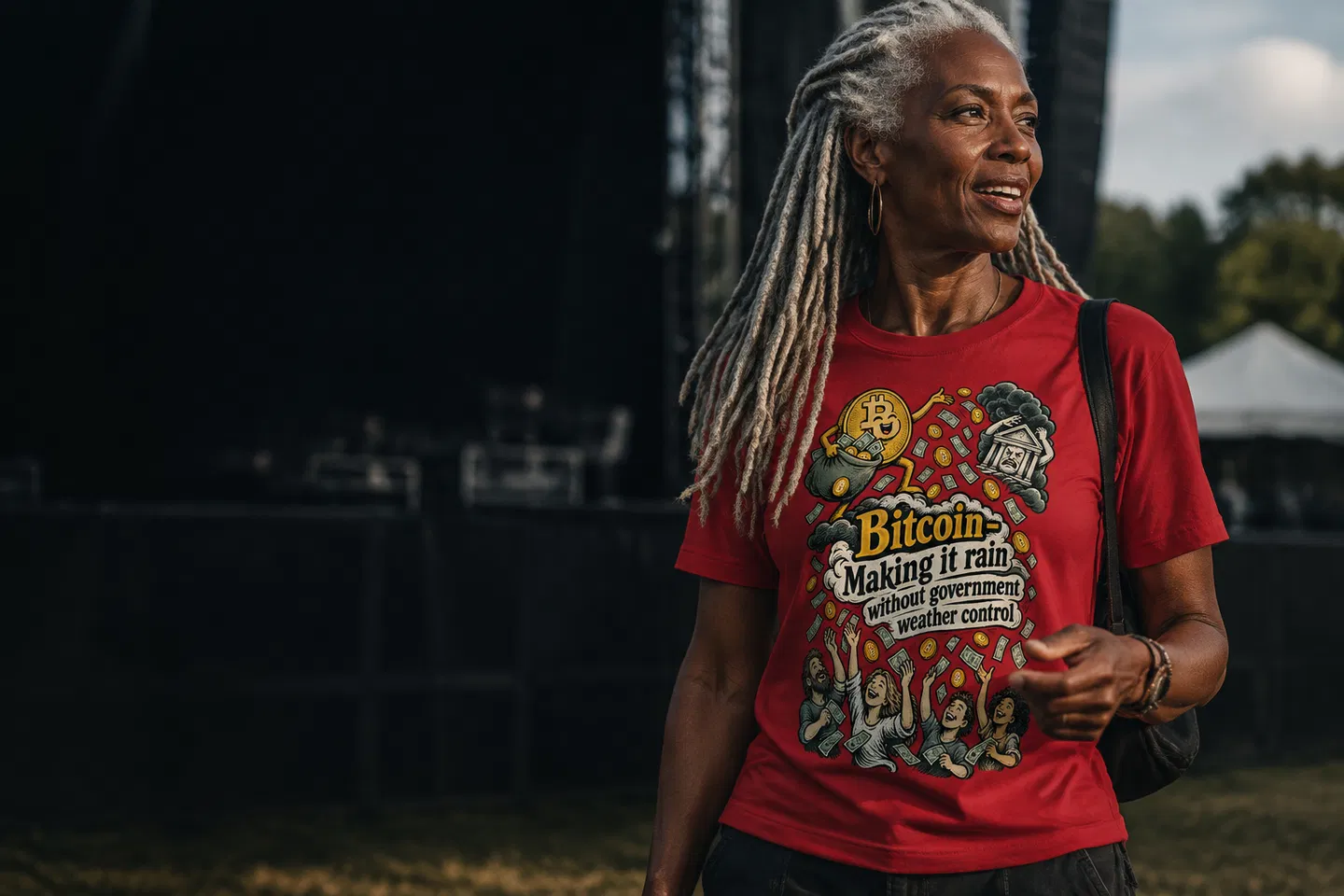
Our Bitcoin “Making it rain without government weather control” T-shirt is a concrete example of choosing humour as the message. Its title brings together a familiar expression and a joke about government control. It should be read as a slogan, not as evidence that Bitcoin is unaffected by public policy or economic conditions. The distinction leaves room to enjoy the wording without treating it as a factual explanation.
For everyday styling, we would give a word-led tee space to be read: plain trousers and an open overshirt are one option. That is a personal styling suggestion, not a claim about what Devcon attendees wore. More importantly, choose wording you would be comfortable discussing. A good starting question is whether you like the joke itself, rather than whether it appears to advertise membership of the right group.
What separates a keepsake from a chosen tee?
An event-made keepsake has a connection to an activity through its provenance: it may recall something a person helped make. An independently chosen tee has a different relationship to its wearer. It can express an interest, a sense of humour or an affinity without documenting attendance anywhere. Neither object needs the other’s story to be meaningful, and the difference should remain clear when discussing them.
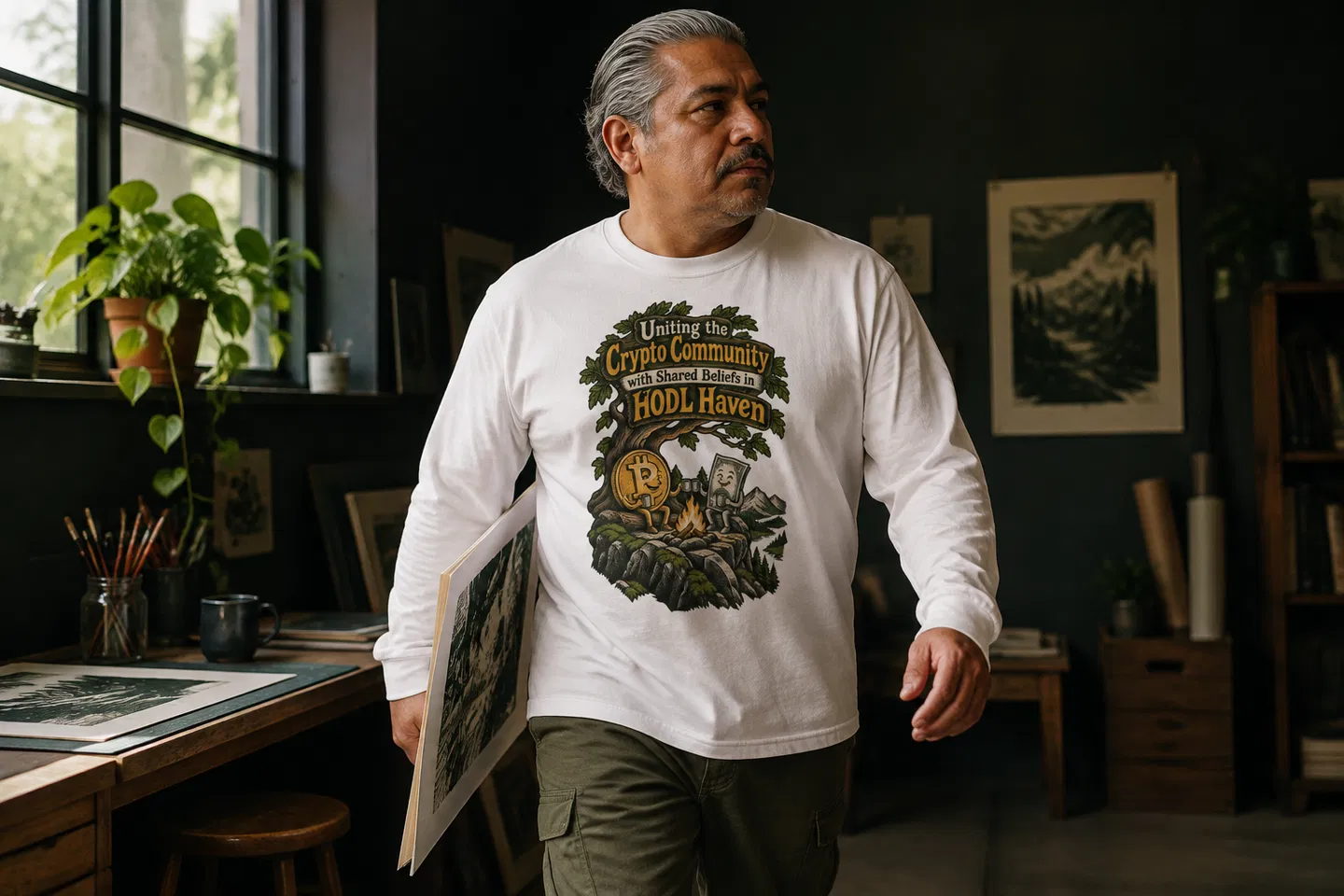
Our HODL Haven long-sleeve T-shirt offers a community-focused reference through its title and the familiar term “HODL”. Someone might choose that language because it resonates with their understanding of crypto culture. Wearing it is not a financial recommendation, proof of particular holdings or evidence of belonging to a specific organised group. It is also not official Devcon merchandise.
The vocabulary helps make the choice more deliberate. A Community Hub names an interest to explore; poster-making names an activity; screen printing names a process. A graphic tee is something you choose to wear. Devcon’s announced programme gives us a reason to consider how those things can meet, while keeping their differences intact. Start with the activity or phrase you genuinely enjoy, then choose clothing that expresses that connection without adding a history it does not have.